Perkembangan penelitian dalam beberapa dekade terakhir telah memperkenalkan konsep IoT dalam beberapa skenario aplikasi industri, yang mengarah ke apa yang disebut Industri 4.0 atau Industrial IoT (IIoT). Industri 4.0 memiliki ambisi untuk merevolusi manajemen industri dan proses bisnis, meningkatkan produktivitas teknologi manufaktur melalui pengumpulan dan analisis data lapangan, sehingga menciptakan digital twins skenario industri secara real-time.
Bagaimana dengan digitalisasi proses kendali mutu dan evolusi IIoT baik dalam digitalisasi maupun optimalisasi kegiatan perencanaan produksi disektor manufaktur?
Menghadirkan pembicara:
1.Firmansyah – Kepala Sub Bidang Industri Tekstil Kementerian Perindustrian Republik Indonesia
2.Edward Christian – Data Science and Data Engineering Lead of ZebraX
3.Chendy Jaya – CEO of Imajin
Moderator:
Fita Indah Maulani – Sekjen ASIOTI
Cari tau jawabannya, hanya di IoT Talk edisi kelima yang mengangkat topik “IoT for Smart Manufacturing: Optimizing Business Processes in an Evolving Manufacturing Factory”. Daftar sekarang di www.bit.ly/iottalk5
IoT Talk 5th Edition Selasa, 27 October 2020 14.00 – 15.30 Via Zoom Webinar
The first round of virtual conferences among the Covid-19 pandemic is behind us. The IoT Analytics team attended 12 virtual conferences during the second quarter of 2020, each with a focus on the enterprise technology stack and each with some relevance for the Internet of Things.
The 12 virtual conferences attended include:
Alibaba Cloud Summit
AVEVA World Digital
AWS Summit
Microsoft Build
Cisco Live
Huawei Analyst Summit
IIOT World Days
PTC LiveWorx
Siemens Realize Live
Rockwell Automation ROK Live
SAP Sapphire Reimagined
Wirepas Go
IoT Analytics corporate research subscribers have access to the complete 50-page summary document of all conferences, titled: Technology Vendor News – Q2/2020
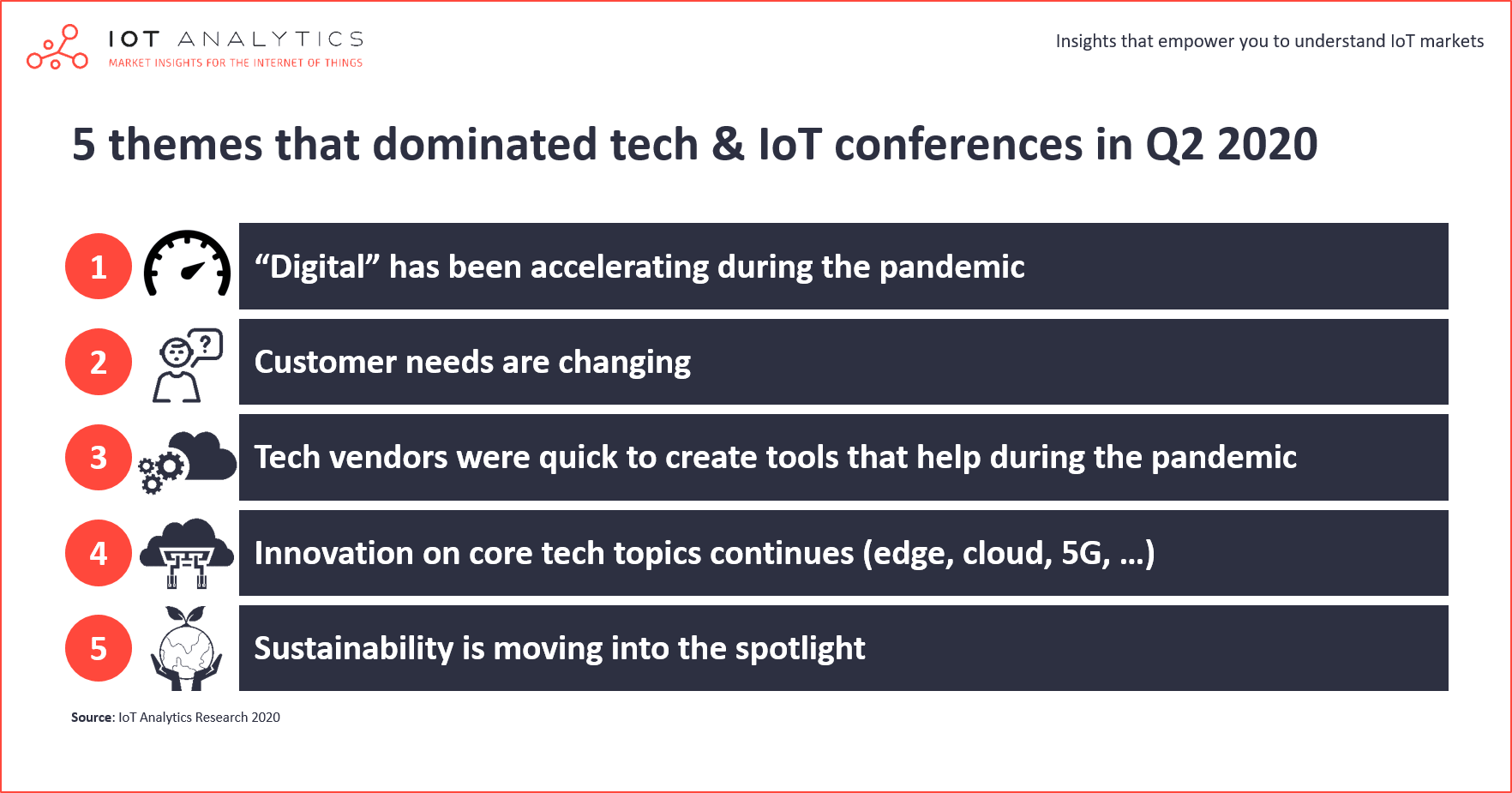
These are 5 of the top themes that emerged when comparing the insights gained at each of the conferences:
1. “Digital” has been accelerating during the pandemic
Tech vendors unanimously echo that adoption of many digital technologies has been accelerating. A survey presented by Oden Technologies at IIoT World showed that 71% of organizations give greater importance to digital transformation now. PTC, at their Liveworx conference, highlighted that factory collaboration tools and data security are two hot themes for them and that the migration to the cloud is accelerating. Schneider Electric and AVEVA highlighted “remote everything” as well as “digital for sustainability” as two of the themes accelerated by Covid-19.
2. Customer needs are changing.
“Covid-19 has shown companies what it means to have IT capacity as a fixed cost in P&L. A clear trend towards modernization is emerging”
Klaus Buerg, Managing Director, AWS, Germany
Siemens, at their Realize Live conferences, reported an increasing demand for rapid application development (with bookings for Siemens Mendix rising 145% yoy) as well as fast production of new products in need enabled by 3D-printing. For Schneider Electric CEO Jean-Pascal Tricoire, the new theme for customers is “resiliency”, either in terms of cost reductions (e.g., the transportation industry) or more capacity and robustness (e.g., food&beverage industry).
3. Tech vendors were quick to create tools that help during the pandemic
Many tech vendors quickly reacted to the pandemic and created tools to help customers and the public. SAP for example teamed up with Deutsche Telekom to co-develop a Corona warning app in Germany which was in use by ~20% of the German population just 3 weeks after release. Both AWS and Microsoft created a centralized database for relevant Covid data (AWS Covid data lake, Microsoft open machine readable research database). Amazon also provided support for testing and made disaster response credits available to communities who were looking for business continuity in the cloud. PTC teamed up with Ansys and Microsoft to help build Covid-19 isolation units based on their Windchill PLM software. The company also provided free access to Vuforia Chalk, a tool that leverages AR to enable remote operations, maintenance, and repair. Siemens helped some of their customers operate differently. A notable example is that of Vietnamese automobile firm Vinfast which managed to produce 55,000 ventilators in a month thanks to Siemens’ Digital Twin tools.
4. Innovation continues on core tech topics such as edge, cloud, digital twins, and next generation communication networks
Both AWS and Alibaba announced their next generation elastic compute services during Q2/2020, which are based on faster processors that promise the customer a much better price to performance ratio. Microsoft highlighted its new Azure-powered supercomputer that is particularly geared towards leveraging Artificial Intelligence at scale. Schneider Electric/AVEVA are making a push at the edge by announcing new partnerships with Lenovo and Stratus. The standout topic for Siemens is the company’s focus on no-code/low-code through its Mendix acquisition. Siemens plans to use Mendix as its platform for building new SaaS solutions (e.g., Teamcenter X). Rockwell Automation announced new edge hardware (i.e., new gateways, PLCs that run HMI software). The company also announced several deep product integrations with PTC ThingWorx (e.g., connecting Rockwell’s historian to ThingWorx). PTC, which historically had a very strong on-premise business, announced plans to eventually make all software solutions available as Software-as-a-Service in the cloud (enabled by its Atlas platform). Huawei and partners jointly launched the Fifth Generation Fixed Network (F5G) industry initiative which aims to bring the fragmented ecosystem of the fixed network industry together and promote topics such as “fiber to everywhere” (as opposed to “fiber to the home”). Cisco put a big focus on the security of its software-defined wide area network architecture (SD-WAN) which promises cheaper connectivity, faster data throughput, and more commercial flexibility.
5. Sustainability is moving into the spotlight
One of the emerging themes is a stronger focus on sustainability. SAP announced its new “Climate 21” initiative which aims to embed a number of sustainability metrics into SAP’s products with the first such module being a “Carbon Footprint Analytics” application. Both Siemens and Schneider Electric/AVEVA spent a significant amount of time at their respective conferences highlighting how their customers use their tools to build products that reduce environmental impact.
APTIKNAS kembali membuat VIRTUAL EVENT bekerjasama dengan EVENTCERDAS.COM dengan topik "APTIKNAS SMART CITY AND IOT SOLUTIONS DURING COVID-19 PANDEMIC"
APTIKNAS mengundang anggotanya dan para mitra untuk mencari solusi IT terbaik yang bisa digunakan untuk membantu perusahaan dan instansi selama masa pandemi Covid-19
Silahkan segera mendaftar untuk mendengarkan solusi-solusi yang tepat untuk anda.
Segera melakukan pendaftaran di WWW.EVENTCERDAS.COM , kegiatan ini adalah FREE (tidak dipungut biaya) dan peserta yang hadir akan mendapatkan e-sertifikat. Silahkan pilih mau ikut tanggal 8 atau ikut juga tanggal 14 Mei 2020.
Internet of Things (IoT) sangat berkembang sangat pesat dalam beberapa tahun ini, dan telah memasuki berbagai bidang kita. Dan IoT tidak bisa melupakan pentingnya keamanan siber (CyberSecurity).
Oleh karena itu, APTIKNAS bekerjasama dengan EVENTCERDAS.COM mengadakan serangkaian Seminar di berbagai Kampus membahas tentang IoT dan Cybersecurity.
Kegiatan ini berbentuk : - Seminar IoT / CyberSecurity di Kampus, dengan tujuan memperkenalkan IoT dan pentingnya CyberSecurity - Seminar IoT & CyberSecurity di Hotel mengundang End User terkait - Workshop Cyber Security Awareness di Kampus.
Dari kegiatan diatas, APTIKNAS berharap semakin banyak orang tertarik mempelajari, menggunakan IoT dan memperhatikan CyberSecurity.
Oleh karena itu, kami mengundang para pihak sponsor yang ingin terlibat dalam kegiatan ini untuk mendukung Seminar yang kami adakan. Beragam solusi terkait endpoint IoT dan CyberSecurity, konektifitas serta aplikasi IoT termasuk semua aplikasi berbasis cloud / Internet dapat ikut serta.
Kontak Fhara 0811-1472-260 / farah@smartcityindo.com untuk mendapatkan harga penawaran terbaik. Silahkan download agenda kegiatan APTIKNAS 2020 di sini (http://bit.ly/aptiknasEC2020)
Kami akan mengadakan workshop pada tanggal 22 Nov 2018 di area Cikarang Industrial Expo , dengan target :
- Umum
- Pelajar / Mahasiswa
Workshop kali ini membahas penggunaan CCTV dan monitoring jaringan, dengan tema "CCTV Network Engineer".
Hal ini berkaitan dengan semakin maraknya kebutuhan CCTV Network Engineer di kalangan anggota APTIKNAS dan ASISINDO yang menaungi banyak perusahaan / usaha berkaitan dengan CCTV.
Silahkan hubungi Nurma 0881-8867333 untuk registrasi.
Kami mengundang Bapak / Ibu / Saudara untuk belajar dan mengetahui tren terkait Smart City, IoT di era Industri 4.0 yang akan diadakan pada tanggal 21 Nov 2018
Seminar ini bersamaan dengan Cikarang Industrial Expo yang diadakan dari tanggal 21 - 23 Nov 2018.
Untuk registrasi dapat ke nomor di atas, atau Nurmah 0881-8867333
Taiwan terus mengembangkan eksistensinya di dunia Teknologi Informasi dan Komunikasi (TIK) melalui perusahaan-perusahaan yang tergabung dalam Taiwan Excellence. Menjadi yang terbesar kedua di dunia, Taiwan Excellence untuk kedua kalinya berpartisipasi dalam Pameran Communic Indonesia di Jakarta. Mereka pun membawa 25 merek perusahaan komunikasi. Seluruhnya bersatu dan membentuk ekosisteminternet of things (IoT).
Secara umum, Taiwan hampir memiliki 20 perusahaan manufaktur yang aktif dalam pengembangan pasar di Indonesia, juga membuka kerjasama kedua negara. Di industri ICT dunia, Taiwan menempati posisi penting dan telah masuk ke pasar-pasar ekspor, seperti ke Amerika Serikat, China, EU, dan sepuluh negara ASEAN. Perusahaan-perusahaan tersebut juga melingkupi pengembangan artificial intelligence (AI), IoT dan teknologi baru di dunia komputer yang diperkirakan nilainya tahun ini mencapai US$ 220 miliar.
Berdasarkan data dari institut penelitian pasar GfK pada Januari 2018, Taiwan sangat kuat di segmen laptop gaming internasional. Data tersebut menyebutkan bahwa peringkat pertama produk laptop gaming dengan harga lebih dari US$ 1.000 per unit diduduki oleh Asus dengan pangsa pasar 22% di seluruh dunia. Sementara, saudara dekatnya Acer, menduduki posisi kelima dengan pangsa pasar 9%.
“Taiwan cukup terkenal di dunia TIK Kondisi ini yang mendorong kerjasama antara Taiwan dan Indonesia,” ujar Franky, Wakil Ketua Umum Asosiasi Sistem Integrator dan Sekuriti Indonesia (ASISINDO).
Melalui pameran ini, Taiwan banyak menampilkan beragam teknologi yang mereka miliki, khususnya yang mendukung ekosistem kota pintar di Indonesia. Di sini, Taiwan Excellence juga mengundang perwakilan dari Geosat Aerospace & Tech yang berbagi soal kondisi industri komunikasi di Taiwan dan mendeskripsikan kerjasama antara Indonesia dengan Taiwan.
Jakarta, Selular.ID – Indonesia dinilai sejumlah perusahaan teknologi asing sebagai pasar yang menjanjikan, seperti vendor asal Taiwan. Nama-nama besar seperti Asus, Acer, HTC, Gigabyte dan lainnya sejak lama hingga kini banyak memboyong produk mereka ke Indonesia. Respon masyarakat Indonesia pun cukup besar terhadap produk mereka.
Melihat potensi tersebut, Taiwan External Trade Development Council (TAITRA) menggelar Taiwan Excellence Day pada 20-22 September 2018 di kawasan Jakarta Selatan. TAITRA sendiri merupakan asosiasi yang menaungi brand taiwan tersebut. Melalui perhelatan ini, Taiwan memboyong 21 brand ternama seperti ACER, Advantech, Edimax, FECA, Noveltek, Silicon Power dan banyak lagi. Acara ini bertujuan memperluas pasar di Indonesia pada tahun 2018.
“Taiwan Excellence sudah melakukan kampanye di beberapa kota di Indonesia sejak tahun 2010. Kota tersebut mencakup Bali, Makassar, Medan, Palembang, Surabaya, Yogyakarta dan Jakarta. Hasil yang dicapai pun cukup signifikan, dimana terdapat peningkatan di sektor ekspor dan impor Taiwan maupun Indonesia,” ujar Danny Liao, Director of Taiwan Trade Center Jakarta melalui keterangan tertulisnya.
Jack Chen-Huan Hsiao selaku Director Economic Division of Taipei Economic and Trade Office (TETO) Indonesia menambahkan bahwa Perdagangan bilateral Taiwan dengan Indonesia pada tahun 2017 hampir mencapai USD 8 Miliar. Dibandingkan tahun sebelumnya terjadi peningkatan sebesar 14% dengan total USD 1 Miliar.
“Kami ingin memperkenalkan produk-produk inovatif berkualitas dari Taiwan kepada masyarakat Indonesia. Kami juga mengundang para pelajar maupun pekerja dari Indonesia untuk memasarkan produk-produk berkualitas asli Indonesia ke Taiwan,” pungkas Jack Chen.
Taiwan Excellence Day yang digelar 20 September 2018 juga menghadirkan sesi seminar bertema Smart Solution Cooperation between Taiwan and Indonesia dengan turut mengundang Wakil Ketua Umum Asosiasi Sistem integrator dan Sekuriti Indonesia (ASISINDO) Fanky Christian, Direktur Sistem dan Teknologi lnformasi ITB yang juga merupakan Ketua Kompartement Smart Model, Standar, Arsitektur dan Teknologi dari Asosiasi Prakarsa Indonesia Cerdas. Kemudian dihadiri oleh Didit Haryanto, Produk Manager Acer Indonesia, Arry Akhmad Arman, Kepala Sektor bidang lIOT Advantech Ramdhani Gumilar dan Chief Representative Officer Edimax Tina Lau. Diskusi tersebut membahas secara mendalam serta menganalisa kecenderungan perkembangan industri cerdas Taiwan dan Indonesia.
“Acer memiliki lini bisnis notebook dan PC, produk IoT dan layanan service center. Market Indonesia yang besar membuat kami optimis memasarkan semua produk Acer,” tutup Didit Haryanto, Produk Manager Acer Indonesia.
The Internet of Things (IoT) is the network of physical objects accessed through the Internet. These objects contain embedded technology to interact with internal states or the external environment. In other words, when objects can sense and communicate, it changes how and where decisions are made, and who makes them. For example Nest thermostats.
The Internet of Things (IoT) is emerging as the third wave in the development of the Internet. The 1990s’ Internet wave connected 1 billion users while the 2000s’ mobile wave connected another 2 billion. The IoT has the potential to connect 10X as many (28 billion) “things” to the Internet by 2020, ranging from bracelets to cars. Breakthroughs in the cost of sensors, processing power and bandwidth to connect devices are enabling ubiquitous connections right now. Smart products like smart watches and thermostats (Nest) are already gaining traction as stated in Goldman Sachs Global Investment Research’s report.
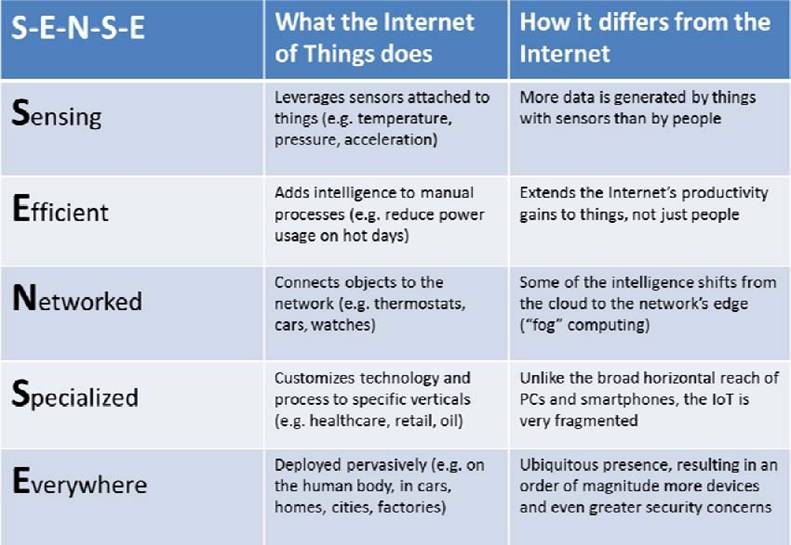
IoT has key attributes that distinguish it from the “regular” Internet, as captured by Goldman Sachs’s S-E-N-S-E framework:Sensing, Efficient, Networked, Specialized, Everywhere. These attributes may tilt the direction of technology development and adoption, with significant implications for Tech companies – much like the transition from the fixed to the mobile Internet shifted the center of gravity from Intel to Qualcomm or from Dell to Apple.
Source: Goldman Sachs Global Investment Research.
A number of significant technology changes have come together to enable the rise of the IoT. These include the following.
Cheap sensors – Sensor prices have dropped to an average 60 cents from $1.30 in the past 10 years.
Cheap bandwidth – The cost of bandwidth has also declined precipitously, by a factor of nearly 40X over the past 10 years.
Cheap processing – Similarly, processing costs have declined by nearly 60X over the past 10 years, enabling more devices to be not just connected, but smart enough to know what to do with all the new data they are generating or receiving.
Smartphones – Smartphones are now becoming the personal gateway to the IoT, serving as a remote control or hub for the connected home, connected car, or the health and fitness devices consumers are increasingly starting to wear.
Ubiquitous wireless coverage – With Wi-Fi coverage now ubiquitous, wireless connectivity is available for free or at a very low cost, given Wi-Fi utilizes unlicensed spectrum and thus does not require monthly access fees to a carrier.
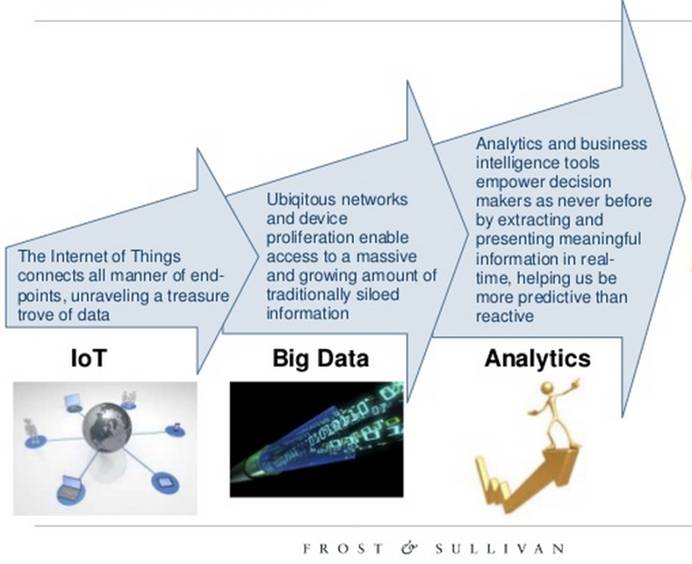
Big data – As the IoT will by definition generate voluminous amounts of unstructured data, the availability of big data analytics is a key enabler.
IPv6 – Most networking equipment now supports IPv6, the newest version of the Internet Protocol (IP) standard that is intended to replace IPv4. IPv4 supports 32-bit addresses, which translates to about 4.3 billion addresses – a number that has become largely exhausted by all the connected devices globally. In contrast, IPv6 can support 128-bit addresses, translating to approximately 3.4 x 1038 addresses – an almost limitless number that can amply handle all conceivable IoT devices.
Advantages and Disadvantages of IoT
Roberto I. Belda explained it well in his article about IoT: Many smart devices like laptops, smart phones and tablets communicate with each other through the use of Wi-Fi internet technology.Transfer these technological capabilities into ordinary household gadgets like refrigerators, washing machines, microwave ovens, thermostat, door locks among others, equip these with their own computer chips, software and access to the Internet and a “smart home” now comes to life.
The Internet of Things can only work if these gadgets and devices start interacting with each other through a networked system. TheAllSeen Alliance, a nonprofit organization devoted to the adoption of the Internet of Things, is facilitating to make sure that companies like Cisco, Sharp and Panasonic are manufacturing products compatible with a networked system and to ensure that these products can interact with each other.
The advantages of these highly networked and connected devices mean productive and enhanced quality of lives for people. For example, health monitoring can be rather easy with connected RX bottles and medicine cabinets. Doctors supervising patients can monitor their medicine intake as well as measure blood pressure, sugar levels and alert them when something goes wrong to their patients online.
In the aspect of energy conservation, household appliances can suggest optimal setting based on the user’s energy consumptionlike turning the ideal temperature just before the owner arrives home as well as turning on and off the lights whenever the owner is out on vacation just to create the impression that somebody is still left inside the house to prevent burglars from attempting to enter.
Smart refrigerators, on the other hand, can suggest food supplies that are low on inventory and needs immediate replenishment. The suggestions are based on the user’s historical purchasing behavior and trends.Wearable technology are also part of this Internet of Things, where these devices can monitor sleeping patterns, workout measurements, sugar levels, blood pressure and connecting these data to the user’s social media accounts for tracking purposes.
The most important disadvantage of the Internet of Things is with regard to the privacy and security issue. Smart home devices have the ability to devour a lot of data and information about a user. These data can include personal schedules, shopping habits, medicine intake schedule and even location of the user at any given time. If these data fall into the wrong hands great harm and damage can be done to people.
The other disadvantage is the fact that most devices are not yet ready to communicate with another brand of devices. Specific products can only be networked with their fellow products under the same brand name. It is good that AllSeen Alliance is making sure connectivity happens but the reality of a “universal remote control” for all these devices and products is still in its infantile development.
Monitoring of Things: Exploring a New World of Data
We love technology. It's what drives our developers. It's what drives our product. It's what drives our marketing. We try to avoid jumping on the bandwagon of every new IT buzzword that's out there—at least if it isn't directly related to a possible application for our customers. That's why we've carefully kept an eye on the Internet of Things (IoT) trend and tried to determine if it's a topic that might offer substantial benefits for our customers in the years to come. We don't know yet if IoT will live up to the hype, but we are convinced that it will have an impact on the way we experience IT—and the time to get prepared is now.
Internet of Things basically means everything is connected, with all its advantages and disadvantages. For the network administrator of the future, this rising complexity will come with a whole new set of challenges. Forget about BYOD (Bring Your Own Device) and start thinking about BYOT (Bring Your Own Thing)—and "thing" could be, if you follow recent IT media articles, everything from a coffee machine to a car that's parked in the underground parking lot of a company. Especially wearables (electronic devices you wear on your body) seem to be one of the first trends within this almost infinite area of applications.
Who Monitors the Monitor?
Wearables often are intended to be used for extended healthcare purposes, for example monitoring a patient's pulse or heart-rate. If there's a sudden drop in the heart-rate, an ambulance could automatically be informed, find the patient via GPS signal and hopefully save his life—but what happens if the software crashes, the device gets disconnected or is simply turned off? The recipient of the body monitoring data also has to be informed about the status of the wearable. You have to monitor the device in order to being able to guarantee a constant flow of reliable body monitoring data. For hospitals equipping their patients with these kinds of wearables, the integration into their IT environment is only a first step. They also have to think about updating their network monitoring strategy. Remember, everything will be connected.
One of the biggest challenges will be to integrate a very heterogeneous group of devices into an already existing network structure. This is even truer for companies in industries with a huge scope of possible "things" to integrate into their network.
The Intelligent Industrial Network: Industry 4.0
Also in the manufacturing industry wearables that, for example, measure the noise exposure of factory workers could be a realistic scenario—but that's just the beginning: imagine assembly lines that are never affected by unplanned downtimes, maintenance work that can be scheduled to an exact point in time, and spare parts that arrive even before a replacement is necessary. No more warning lights that only flash after an error has occurred or after a part has exceeded its life cycle.
This development is known under different terms like Smart Manufacturing or Industrial Internet—in Germany it is called Industry 4.0, which refers to the fourth industrial revolution and was initiated as a project in the high-tech strategy of the German government. The goal is to create intelligent networks along the entire value chain, which can control each other autonomously. Although we might yet stand at the beginning of this revolution, it's important to start planning for the future now. Especially the sensible integration with the existing IT infrastructure should not be taken lightly. What's happening to the data that gets picked up off the machines? It has to be added to the central IT system in order to enable further processing, useful display and a basis for maintenance workers to take action. Monitoring things, in this case complex industrial machines, isn't so different from monitoring network devices—what matters is getting relevant data that can be analyzed and put to a purpose.
The Evolution of Monitoring
As with the different stages of the industrial revolution, also IT is an area that never stops evolving—and network monitoring is a big part of this development. When the concept first was introduced, the technology mostly was used to monitor physical IT devices (Monitoring 1.0), like routers or switches. With the ongoing virtualization of networks, new concepts and functionalities had to be found (Monitoring 2.0) in order to gather and process new kinds of relevant data. The next logical step was to run applications in the cloud and even further extend the virtualization. To enable users of SaaS (Software as a Service) solutions and other cloud applications constant access to their productive environment, the connection to the cloud has to be closely monitored (Monitoring 3.0)—this includes the monitoring of services and resources from every perspective to guarantee the smooth operation of all systems and connections within the cloud.
Besides the necessity to continue monitoring all devices, virtual machines and cloud based applications, which have been monitored in the past, the Internet of Things also launches a new era in network monitoring (Monitoring 4.0) as with every new thing connected to the network, also the amount of data that can and should be monitored, is constantly growing. Due to the heterogeneous nature of "things" and applications, many of which we probably even can't think of today, it will be difficult to have an out-of-the-box solution that covers every possible scenario. Applying custom sensors is a feasible solution, already used by many of our customers. In the past we've seen users of PRTG Network Monitor being on the forefront of creativity, using custom sensors to monitor prawn farms, pellet stokers or even the blood fridge of a hospital—all not being network devices, but "things". We're learning about new applications almost every day and are excited about this development. Based on our customer's feedback, we're constantly improving PRTG and implementing new features, so that when the time has come, our customers will be able to monitor every "thing", they want.
If you can think of an exciting thing to monitor, or even have written a custom sensor yourself, let us know: mot@paessler.com
The rapid growth of interconnected devices making up the Internet of Things will wreak havoc on data security, storage, servers, networks and end user privacy, according to a new report.
There will be 26 billion "things" making up the Internet of Things within six years, according to a report released by Gartner. The implications for IT are profound — in particular for data center operations.
"IoT threatens to generate massive amounts of input data from sources that are globally distributed," said Joe Skorupa, vice president and distinguished analyst at Gartner, in a statement released to coincide with the report. "Transferring the entirety of that data to a single location for processing will not be technically and economically viable. The recent trend to centralize applications to reduce costs and increase security is incompatible with the IoT. Organizations will be forced to aggregate data in multiple distributed mini data centers where initial processing can occur. Relevant data will then be forwarded to a central site for additional processing."
He added that the effects will impact ore than just centralized applications. "The enormous number of devices, coupled with the sheer volume, velocity and structure of IoT data, creates challenges, particularly in the areas of security, data, storage management, servers and the data center network, as real-time business processes are at stake," he said. "Data center managers will need to deploy more forward-looking capacity management in these areas to be able to proactively meet the business priorities associated with IoT."
Significant implications noted in the report included:
Given the volume of data, comprehensive backups "will present potentially insoluble governance issues, such as network bandwidth and remote storage bandwidth, and capacity to back up all raw data is likely to be unaffordable";
This, in turn, will lead to the need for automated selective backups;
Availability requirements will continue to grow even as the IoT builds, "putting real-time business processes and, potentially, personal safety at risk";
The potential for breaches of individual privacy will increase.
Fabrizio Biscotti, research director at Gartner, said the advent of the Internet of Things will push IT further into virtualization and the cloud.
According to Patrick Gray, the "invasion of things" is already underway. Make sure your organization is prepared to use the new technology to its advantage instead of struggling to catch up.
While the Internet of Things (IoT) should not be an unfamiliar term to most IT executives, many consider it primarily a consumer technology that's dominated by smart watches and refrigerators that will tweet when you’re out of milk. Many of the IoT concepts have indeed targeted the consumer, but most of the major technology innovations of the past several years have originated in the consumer space, and the IoT is no exception.
The "things" are coming, like it or not
One of the biggest impacts to the enterprise is that the number and variety of devices connecting to your networks and potentially consuming IT resources is likely to increase exponentially. Consider that the typical enterprise today has one or two devices per user. If that enterprise lacks a BYOD policy, those devices might be part of a dozen or so potential configurations powered by a handful of operating systems. As BYOD becomes more widespread, the per-user device count could jump to three or four devices, as personal laptops, tablets, and smartphones complement the corporate-issued laptop.
With the IoT, everything from watches to fitness monitors to intelligent office furniture comes into the mix. In the coming months, a single gadget-obsessed individual might walk through your lobby sporting more connected and communicating devices on his or her person than an entire department had a couple of years ago.
Traditional ideas around endpoint management, which assumed that an IT shop must track, manage, and patch every device that's connected to its network quickly, become untenable when a single employee might have over a half-dozen connected devices, each with a highly-customized OS and wildly different management capabilities. Furthermore, several of these devices may not even appear on your network, such as using a smartphone or computer to communicate with a cloud-based service of unknown providence.
Getting ready for the "things"
Just like non-sanctioned smartphones and tablets caught some organizations flat-footed, so will the onslaught of the IoT, unless your organization takes the time to develop a strategy and response, ideally before the problem manifests itself.
While a prohibition against non-sanctioned devices might be tempting, the experience of most IT leaders with the iPhone provides a clue as to the limited success of such an effort. All it takes to end the most well-intentioned device bans is a CEO who wants his or her new connected device to “just work” while in the office. Rather than a ban on non-work devices, consider a bandwidth-limited visitor/personal network that’s logically or physically separated from your core corporate network. This is an easy solution to the question of personal devices, but not every “thing” that’s likely to wind up coming through your doors will be a personal device.
Shows like CES are full of consumer devices, but the underlying technologies powering these devices -- lightweight operating systems, inexpensive hardware, and long battery life -- are equally applicable to the enterprise. While you may not have an influx of quadcopters, a connected forklift or “smart” pallet is highly likely as prices fall, due to consumer devices driving down prices. This means hundreds or even thousands of new devices connecting to your network, sending and receiving information, and requiring tools and infrastructure to analyze the data they generate.
If there’s not at least a line item in your future budgets -- and better yet, an initial technology strategy and lab where you’re testing the impact of the IoT on your business -- you’ll likely be playing a game of catch-up as your network strains to serve an exponential increase in devices, and your peers in the business will demand reports from tools you haven’t yet built. Like it or not, the “invasion of things” is currently underway. Like most technology shifts, the organizations that are prepared will use the new technology to their advantage, while the unprepared will struggle to catch up.
A new wave of smart devices sensors and Internet of Things collecting data will make it hard to remain anonymous offline. Will the public wake up to the risks all of that data poses to their privacy?
Image: iStock/maxkabakov
Should we do something just because we can? That simple question has bedeviled many leaders over the centuries, and has naturally arisen more often as the rate of technological change (e.g., chemical weapons, genetic engineering, drones, online viruses) has increased. In many cases, scientists and engineers have been drawn, as if by siren song, to create something that never existed because they had the power to do so.
Many great minds in the 20th century grappled with the consequences of these decisions. One example is theoretical physicist J. Robert Oppenheimer:
"When you see something that is technically sweet, you go ahead and do it and argue about what to do about it only after you've had your technical success," he said, in aCongressional hearing in 1954. "That is the way it was with the atomic bomb."
In the decades since, with the subsequent development of thermonuclear warheads and intercontinental ballistic missiles and arms buildup during the Cold War, all of mankind has had to live with the reality that we now possessed the means to end life on Earth as we know it, a prospect that has spawned post-apocalyptic fiction and paranoia.
In 2014, the geostrategic imperative to develop the bomb ahead of the Nazis is no longer driving development. Instead, there are a host of decisions that may not hold existential meaning for life on Earth but instead how it is lived by the billions of humans on it.
This year, monkeys in China became the first primates to be born with genome editing. The technique used, CRISPR (Clustered Regularly Interspaced Short Palindromic Repeats), has immense potential for use in genome surgery, leaping from lab to industry quickly. CRISPR could enable doctors to heal genetic disorders like sickle-cell anemia or more complex diseases in the future. Genome surgery is, unequivocally, an extraordinary advance in medicine. There will be great temptations in the future, however, for its application outside of disease.
While Google turns facial recognition off by default, Facebook has it on and suggests people to tag when users upload photos, thereby increasing the likelihood that people will be identified. As always, the defaults matter: such tagging adds more data to Facebook's servers, including "shadow profiles" of people who may not have created accounts on the service but Facebook knows exists.
Several news stories from the past week offer more examples of significant choices before society and their long-term impact, along with a lack of public engagement before their installation.
The New York Times reported that a new system of "smart lights" installed in Newark's Liberty International Airport are energy efficient and are also gathering data about the movements of the people the lights "observe." The lights are part of a wireless system that sends the data to software that can detect long lines or recognize licenses plates.
The story is an instructive data point. The costs of gathering, storing, and analyzing data through sensors and software are plunging, coupled with strong economic incentives to save energy costs and time. As The New York Times reported, such sensors are being integrated into infrastructure all around the world, under the rubric of "smart cities."
There are huge corporations (including Cisco, IBM, Siemens, and Philips) that stand to make billions installing and maintaining the hardware and software behind such systems, many of which I saw on display in Barcelona at the Smart Cities Expo years ago. A number of the wares' potential benefits are tangible, from lower air pollution through reduced traffic congestion to early detection of issues with water or sewage supplies or lower energy costs in buildings or streetlights.
Those economic imperatives will likely mean the questions that legislators, regulators, and citizens will increasingly grapple with will focus upon how such data is used and by whom, not whether it is collected in the first place, although parliaments and officials may decide to go further. "Dumbing down" systems once installed or removing them entirely will take significant legal and political action.
The simple existence of a system like that in the airport in Newark should be a clarion call to people around the country to think about what collecting that data means, and whether it's necessary. How should we weigh the societal costs of such collection against the benefits of efficiency?
In an ideal world, communities will be given the opportunity to discuss whether installing "smart" streets, stoplights, parking meters, electric meters or garages--or other devices from the much larger Internet of Things--are in the public interest. It's unclear whether local or state governments in the United States or other countries will provide sufficient notice of their proposed installation to support such debate.
What will happen next on this count is unclear, at least to me. While the increasing use oflicense plate scanners has attracted the attention of the American Civil Liberties Union, Congress and the Supreme Court will have to ultimately guide their future use and application.
They'll also be faced with questions about the growing use of sensors and data analysis in the workplace, according to a well-reported article in the Financial Times. The article's author Hannah Kuchler wrote, "More than half of human resources departments around the world report an increase in the use of data analytics compared with three years ago, according to a recent survey by the Economist Intelligence Unit."
Such systems can monitor behavior, social dynamics, or movement around workspaces, like the Newark airport. All of that data will be discoverable; if email, web browsing history, and texts on a workplace mobile device can be logged and used in e-discovery, data gathered from sensors around the workplace may well be too.
"The message to government employers is that the courts will continue to scrutinize employers' actions for reasonableness, so supervisors have to be careful," said Jim Dempsey, the Center for Democracy and Technology's vice president for public policy, in an interview. "Unless a 'no privacy' policy is clear and consistently applied, an employer should assume that employees have a reasonable expectation of privacy and should proceed carefully, with a good reason and a narrow search, before examining employee emails, texts, or Internet usage."
Just as a consumer would do well to read the Terms and Conditions (ToC) for a given product or service, so too would a prospective employee be well-advised to read his or her employment agreement. The difference, unfortunately, is that in today's job market, a minority of people have the economic freedom to choose not to work at an organization that applies such monitoring.
If the read-rate for workplace contracts that includes data collection is anything like that for End User License Agreements (EULAs) or ToC, solely re-applying last century's "notice and consent" model won't be sufficient. Expecting consumers to read documents that are dozens of pages long on small mobile device screens may be overly optimistic. (The way people read online suggests that many visitors to this article never made it this far. Dear reader, I am glad that you are still with me!)
All too often, people treat any of the long EULAs, ToC, or privacy policies they encounter online as "TL;DR"--something to be instantly scrolled through and clicked, not carefully consumed. A 2012 study found that a consumer would need 250 hours (a month of 10-hour days) to read all of the privacy policies she encountered in a year. The answer to the question about whethermost consumers read the EULA, much less understand it, seems to be a pretty resounding "no." That means it will continue to fall to regulators and Congress to define the boundaries for data collection and usage in this rapidly expanding arena, as in other public spaces, and to suggest to the makers of apps and other digital services that pursuing broad principles of transparency, disclosure, usability, and "privacy by design" is the best route for consumers and businesses.
While some officials like FTC commissioner Julie Brill are grappling with big data and consumer privacy (PDF), the rapid changes in what's possible have once again outpaced the law. Until legislatures and regulators catch up, the public has little choice but to look to Google and Mark Zuckerberg's stance on data and privacy, the regulation of data brokers and telecommunications companies, and the willingness of industry and government entities to submit to some measure of algorithmic transparency and audits of data use.
There's hope in the near future that the public will be more actively engaged in discussing what data collection and analysis mean to society, either through upcoming public workshops on privacy and big data convened by the White House at MIT, NYU, and the University of California at Berkeley, but public officials at every level will need to do much better at engaging the consent of the governed. The signs from Newark and Chicago are not promising.